

Whether you’re looking to transport your horse for a show, to take it to the vet, or simply because you want to go for a ride somewhere different, a horse trailer is vital for any horse or pony owner.
But can you tow a horse trailer on a car licence? We examine the rules.
Can I tow a horse trailer using my car licence?
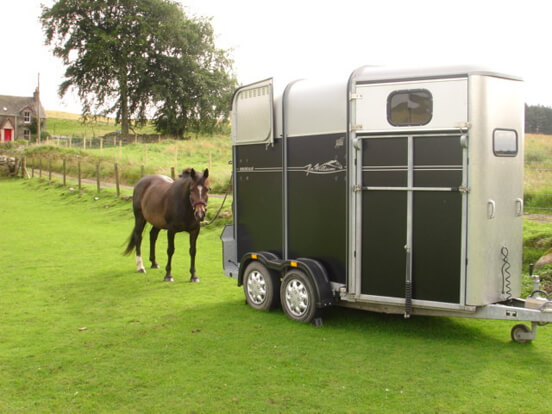
When towing a horse trailer, the licence requirement will depend on the type of vehicle you’re using to tow it and how much the combined vehicle and trailer weighs.
Thankfully, the rules around towing a trailer changed on the 16th December 2021 and have become much simpler for horse owners. By default, anyone who has a Category B licence will automatically get the BE Category added to their driving licence.
Whereas previously, most drivers had to complete a test to be eligible to tow a trailer over a certain weight, Category B licence holders can now tow a range of trailers without having to complete any further tests. The weight you can tow depends on when you passed your driving test.
You passed your driving test before 1st January 1997
If you have a Category B licence and you passed your test before 1st January 1997, you’re usually able to drive a vehicle and trailer combination up to 8,250kg maximum authorised mass (MAM). Note that this includes the weight of your horses, as well as any equipment or items you’re transporting too.
It’s important to remember that the weight you can tow also depends on your vehicle’s maximum towing capacity, which we explain a little further down.
You passed your driving test on or after 1st January 1997
If you passed on or after the 1st of January 1997, you can tow a trailer with a maximum authorised mass of 3,500kg.
There are some stipulations to this though, which we cover next.
Make sure you check your car’s maximum towing capacity
It’s important that, regardless of when you passed your driving test, you check your car’s maximum towing capacity. You can usually find this information in the vehicle’s manual, on the vehicle’s vehicle identification number plate, which is normally under the bonnet, or on the inside of the driver’s door. If you can’t find it, it’s best to get in touch with the vehicle manufacturer.
Even if your licence allows you to tow a horse trailer up to 3,500kg, if you own a car that cannot tow anything more than, say, 2,000kg, you legally are not allowed to tow more than this weight. If you did want to tow the maximum 3,500kg, you would have to opt for a vehicle with a higher towing capacity.
Is your car big enough to tow?
Even if you think you meet the legal requirements, stop and think about whether your car is suitable for towing. Remember, if you’re planning to take your horse to a competition or somewhere new for a ride, you may need to drive through muddy fields. If your car is too small or doesn’t have enough power it could be dangerous.
What if I have a horse lorry?
If you’ve opted to purchase a horse lorry, otherwise known as a horsebox, you can drive one of these on your Category B licence as long as it’s 3,500kg MAM or less.

If you need to transport multiple horses and therefore need more space in your vehicle, you’ll need to get a Category C1 licence. This will allow you to drive a horsebox that’s between 3,500kg and 7,500kg MAM (the equivalent of a light goods vehicle, or LGV). You can also tow a trailer up to 750kg. Adding the +E entitlement will allow you to tow trailers over 750kg.
Note that if you passed your driving test before 1st January 1997, it’s likely that you already have this entitlement on your licence.
If you need to drive a bigger horsebox, you will need a Category C licence, which allows you to drive any vehicle over 3,500kg, including larger horseboxes and HGVs. You can also tow a trailer up to 750kg with this licence. Adding the +E entitlement will allow you to tow trailers over 750kg.
If you think you’ll eventually need to drive bigger vehicles to tow your horses, consider getting a Category C licence immediately as this will include C1 entitlement too.
Whichever you choose, you must first apply for a provisional licence from the DVLA. You’ll also need to pass a medical to ensure you’re able to drive an LGV or HGV. After this, you can take your theory test and start practising with a qualified instructor to get you ready for your test.
You’ll also need a separate Driver Certificate of Professional Competence (CPC) qualification when driving vehicles over 3,500kg for commercial purposes. Note that if you don’t transport horses as the main part of your job, you won’t need to get the full Driver Certificate of Professional Competence (CPC) qualification. Instead, after you’ve applied for a provisional licence, you only need to pass three out of the five Driver CPC qualification tests:
- Theory test (includes a hazard perception test)
- Off-road exercises
- On-road driving test
As part of your development, you’ll need to complete at least 35 hours of training every five years for this to remain valid.
If you’re transporting your horses for commercial reasons on journeys of 65km (40.4 miles) and over, you’ll also need an animal transportation certificate of competence.
For this, you can either train for short journeys (i.e. over 65km and less than eight hours) or long journeys (i.e. anything over eight hours). Whichever you choose, you’ll get a Level 2 Award in Animal Transport by Road certificate in that specific qualification, which is valid for life.
What happens if I don’t have the right type of licence?
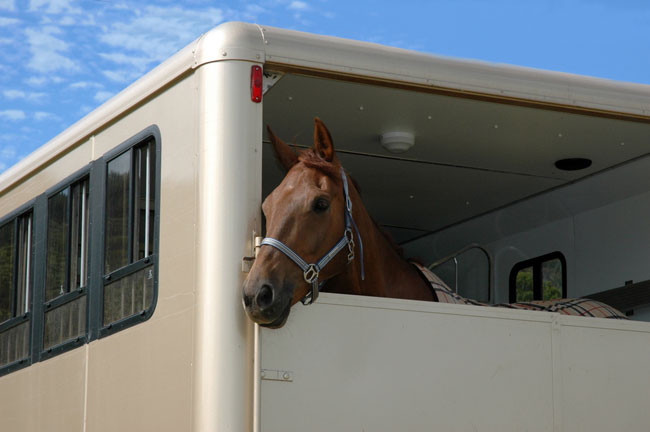
Failure to have the right licence and the right car or horsebox insurance can result in hefty fines, points on your licence and, in some rare cases, prison.
Best cars for towing a horse trailer
Kia Sorento
The Kia Sorento is a large SUV that is more than capable of towing a horse trailer. The all-wheel-drive system will help those who will inevitably need to drive off-road, whilst it also has a hill-start assist and a trailer stability function to make towing even safer.
With prices starting at just over £30,000, the Sorento offers genuine value for money for a large SUV.
Land Rover Discovery
This may seem like the most basic option, but there’s a reason why horse owners love to use a Land Rover Discovery when towing a trailer. In common with everything built by Land Rover, it’s as much at home on a muddy track as it is on the road.
Its four-wheel-drive system can take the Discovery to some inhospitable places. It also comes with huge storage options. The maximum towing capacity for this vehicle is 3,500kg.
Audi Q7
The Audi Q7 is a rather large SUV, but when towing a horse trailer, the last thing you want is a car that feels inferior to your trailer. This vehicle is known for its comfortable seats, impressive torque and trailer-assist system, perfect for pulling.
You can even opt for a more environmentally friendly option such as the plug-in hybrid or the e-tron. The Maximum towing capacity: 3,500kg.
Toyota Hilux
Toyota may not be the first manufacturer you think of when discussing vehicles to tow a horse trailer, but the Hilux is perfect for these occasions. The Japanese car is known for being incredibly tough, being able to pull a trailer up hills, down muddy lanes and any other tough terrain you may come across.
The Hilux lineup ranges from single-cabs right through to highly specced double-cab trucks that offer tough looks and luxuries. The maximum towing capacity: 3,500kg.
Can I get horse trailer insurance through Adrian Flux?
A horse trailer is so much more important than regular towing equipment, especially when it’s carrying your precious animal or animals. At Adrian Flux we offer horse trailer insurance tailored to your needs and budget.
The best deals are usually done over the phone. Call 0800 369 8590 or request a callback at a time that suits you.